
What actually happens to a team that never meets in person?
The short answer: the work keeps moving, but the connective tissue slowly thins. Microsoft tracked this across 61,000 employees and found that remote work made collaboration networks more siloed over time. Bridges between teams disappeared. Relationships that never formed couldn't carry the load when things got complicated.
That's the problem offsites solve. Not just morale, not just fun—Atlassian found that a single in-person gathering produced a 27% increase in feelings of connection that held for four to five months. One event, months of downstream benefit.
This guide covers what makes offsites worth the investment for distributed teams, when to hold them, and how to design them so the value doesn't evaporate the moment everyone boards their flights home.
What Are Offsites for Distributed Teams?
An offsite is a structured, in-person gathering that pulls a distributed team out of their normal remote work context with a specific business purpose. It is not a vacation or a team happy hour. Offsites take many forms: multi-day company retreats, leadership summits, sales kickoffs, project kickoffs. The defining feature is that they bring people together with intention, not just proximity.
Distributed teams, those spread across cities, time zones, or countries, rely on offsites as their primary vehicle for face-to-face connection since they do not share a physical office day-to-day. For these teams, an offsite is not a nice-to-have. It is the main event.
Why Do In-Person Events Create Real Value?
Virtual tools are excellent for executing work, but they cannot replicate the conditions that build trust, unlock creativity, and align people around shared direction. The breakdown happens upstream, before execution even begins.
A Stanford study published in Nature found that videoconferencing groups were just as effective at selecting which ideas to pursue as in-person groups. The same study found that videoconferencing inhibited the production of creative ideas compared to in-person collaboration, with in-person pairs generating more novel and original concepts. The researchers linked this to narrower cognitive focus: screen-centered gaze and attention compress the mental space where new ideas form.
How Do Offsites Build Trust and Relationships?
Trust between remote colleagues builds slowly over text and video, but accelerates dramatically in person. A large-scale study of 61,182 Microsoft employees found that firm-wide remote work made collaboration networks more siloed and static, with fewer bridges between disparate parts of the organization. A separate study tracking a large university email network attributed the loss of co-location to more than 4,800 weak ties disappearing over 18 months, connections that partially regenerated when partial co-location returned.
Body language, facial expressions, and spontaneous side conversations carry information that video calls cannot capture. Physical presence allows colleagues to read intent and tone more accurately, reducing the kind of misunderstandings that pile up over months of async communication.
Key relationship benefits from in-person offsites include:
- Relationship depth: Face-to-face time creates multi-dimensional connections that go beyond job titles and Slack handles
- Trust acceleration: Physical presence allows colleagues to read intent and tone more accurately, reducing misunderstandings
- Social capital refill: In-person gatherings restore the relational reserves that remote work steadily depletes
How Do Offsites Improve Communication and Ideas?
In-person teams generate meaningfully more ideas than virtual ones, and those ideas score higher on originality. The Stanford research showed that in-person pairs demonstrated greater "forward flow," where ideas became less semantically tied to earlier ideas as brainstorming progressed, with differences emerging notably by around the 11th idea in the sequence.
Miro's offsite write-up describes cross-functional progress happening through "serendipitous run-ins" in corridors and kitchens, where people grab each other for a few minutes to unblock work without the meeting-scheduling overhead distributed teams rely on. Virtual is great for planned meetings. In-person is great for the unplanned micro-interactions that compress cycle time on cross-functional questions.
How Do Offsites Reconnect Teams to Strategy?
Remote work creates a drift problem: over time, team members become focused on their immediate tasks and lose sight of the bigger picture. Automattic's Grand Meetup, which historically brought the entire company together for a week, served as an explicit substitute for headquarters gravity, delivering strategic alignment and cultural coherence for a company designed to be distributed.
A CEO's vision delivered in the same room carries more weight than the same words in a recorded all-hands. Participants can read the room, ask follow-up questions in real time, and build collective ownership of decisions in ways that async docs and video calls rarely achieve.
When Do Offsites Deliver the Most ROI?
Not every moment calls for an offsite. The ROI is highest when the purpose matches what in-person uniquely enables. Here are the four scenarios where offsites consistently outperform virtual alternatives.
Strategic planning and vision setting
Complex, multi-perspective decisions, including annual planning, product direction, and org design, benefit from the full bandwidth of in-person communication. Decisions made in person tend to have stronger follow-through because participants feel more accountable to commitments made face-to-face.
Team trust and relationship development
The goal is not fun for its own sake, but building the relational foundation that makes remote collaboration more effective for months afterward. Atlassian reports that intentional in-person team gatherings produced a 27% increase in feelings of connection, and the boost lasts four to five months. An offsite is not a three-day morale spike. It is four to five months of elevated connection. This is especially high-ROI for new hires, cross-functional teams that rarely interact, and teams that have experienced conflict or misalignment.
Creative collaboration and complex problem-solving
Creative work, including brainstorming new products, solving operational problems, and designing a go-to-market approach, benefits from the energy and spontaneity of physical co-location. These sessions also benefit from the informal moments around them: the conversation at dinner that unlocks a breakthrough, the whiteboard sketch that happens between sessions.
New hire and culture moments
Onboarding new team members remotely creates a slower, thinner sense of belonging. An early in-person touchpoint, whether a company-wide retreat or a team kickoff, dramatically accelerates cultural integration. New hires gain context, relationships, and a felt sense of what the company actually is that no handbook or Zoom call can replicate.
How Do You Design Offsites Around Business Outcomes?
Value does not come from gathering people in a room. It comes from designing the gathering with clear intent. A poorly designed offsite can damage morale and waste significant budget.
Define goals before the agenda
Before booking a venue, you should be able to answer: what do we want people to feel, know, and do differently after this event? These goals also become the measurement framework. You cannot evaluate ROI without knowing what you were trying to achieve.
Frame your goals across three dimensions:
- Relational goals: What connections do we want to strengthen or create?
- Strategic goals: What decisions, alignments, or priorities need to come out of this?
- Cultural goals: What do we want people to understand or feel about the company?
Match the location to the work
The venue and destination are not just logistics. They shape the energy and tone of the event. A creative offsite benefits from an inspiring, novel environment. A strategic planning session may call for a more focused, distraction-free setting.
Accessibility matters for distributed teams: the location should minimize travel burden inequity, particularly for international team members. BoomPop's destination guides and curated venue sourcing help planners match location to event type without starting from scratch.
Balance work sessions with unstructured time
The most effective offsites do not pack every hour with structured programming. Unstructured time, including shared meals, free evenings, and informal downtime, is where many of the highest-value conversations happen. Intentional programming should leave room for organic connection, not crowd it out.
A practical time allocation looks like this:
- Structured sessions: Workshops, planning sessions, keynotes designed for specific outputs
- Semi-structured time: Group meals and facilitated activities designed for connection
- Unstructured time: Free evenings and open exploration where unexpected value often emerges
Plan the follow-through before everyone leaves
Offsite value decays rapidly without follow-through. Decisions made in the room need owners and deadlines before people board their flights home. The post-event period is where ROI either compounds or evaporates.
How Do You Measure Offsite ROI?
Offsite ROI is real but not always easy to quantify in a spreadsheet. Measurement works best when it combines soft signals with harder operational data.
Track engagement and belonging
Post-event surveys are the most accessible measurement tool. Attendee NPS (Net Promoter Score) is a common proxy, and these scores have real business implications since engagement directly correlates with retention and productivity.
Key survey signals to track include:
- Connection to team: Did people leave feeling closer to their colleagues?
- Clarity on direction: Did the offsite improve understanding of company goals?
- Sense of belonging: Did attendees feel more invested in the company after the event?
- Energy and motivation: Did people return to work re-energized?
Track collaboration and execution speed
Some ROI shows up in the weeks after an offsite, not immediately. Teams that have met in person tend to communicate more fluidly, resolve conflicts faster, and execute with less friction. Managers are often the best source of this data. A brief post-event check-in with team leads can surface qualitative signals worth documenting.
Track budget, time, and vendor savings
Hard ROI comes from the cost side as well as the output side. Key inputs to track include:
- Total event cost vs. budget: Did the event come in on target?
- Vendor savings: What discounts were secured through negotiated rates vs. market rate? BoomPop's vendor network offers discounts up to 40% on hotels and vendors, a concrete, documentable saving that offsets platform cost.
- Planning hours: How many internal hours went into logistics?
During a month of planning an event, 42% of planners reported working 15 to 20 hour days. If an HRBP and EA spend a combined 25 to 40 hours on sourcing, contracting, and admin for one offsite, and your loaded labor rate is $60 to $120 per hour, that is $1,500 to $4,800 in internal labor before you count legal review, finance reconciliation, and the opportunity cost of not doing core work.
Pair survey data with team stories
Numbers alone rarely win a budget conversation. Collect two or three specific anecdotes from attendees: a relationship formed, a decision unlocked, a moment of clarity. Documented stories become the institutional memory that makes the next offsite easier to justify.
What Can Reduce Offsite ROI?
Based on planner feedback and post-event surveys, these are four of the most common ways offsite value gets left on the table, and each one is avoidable with a little foresight.
Unclear goals
The single biggest ROI killer is an offsite planned around a venue, not a purpose. When the agenda is built to fill time rather than achieve outcomes, participants leave with warm feelings but no clear change in behavior, alignment, or direction. Define three measurable outcomes before any logistics are confirmed.
Travel inequity
For globally distributed teams, a poorly chosen location can create a two-tier experience where some attendees arrive fresh and local while others are jet-lagged after 20-hour journeys. Rotate locations across years, build in arrival buffer days for long-haul travelers, and be explicit about travel support.
Hidden costs
Budget surprises are one of the most common offsite pain points, and one of the most damaging to planner credibility. Hotel attrition clauses commonly require 75% to 90% room block pickup before penalties kick in, creating real downside if headcount shifts. Service charges on food and beverage often add 21% to 26% on top of minimums, and taxes may stack on top. BoomPop's sourcing process surfaces these costs early, before contracts are signed.
No post-event action plan
An offsite without follow-through is a morale event, not a business investment. If the strategic decisions made on day two do not have owners and timelines by day three, they will dissolve within two weeks. Build a 30-day action plan into the offsite agenda itself as a structured closing session, not an afterthought.
How Can the Right Event Partner Make Offsites Easier to Prove?
Your job is not to become an expert in hotel contracts and vendor coordination. It is to deliver an offsite that moves the business forward. The right event partner shifts the operational burden to specialists who handle this on the regular.
Centralize guests, budgets, and agendas
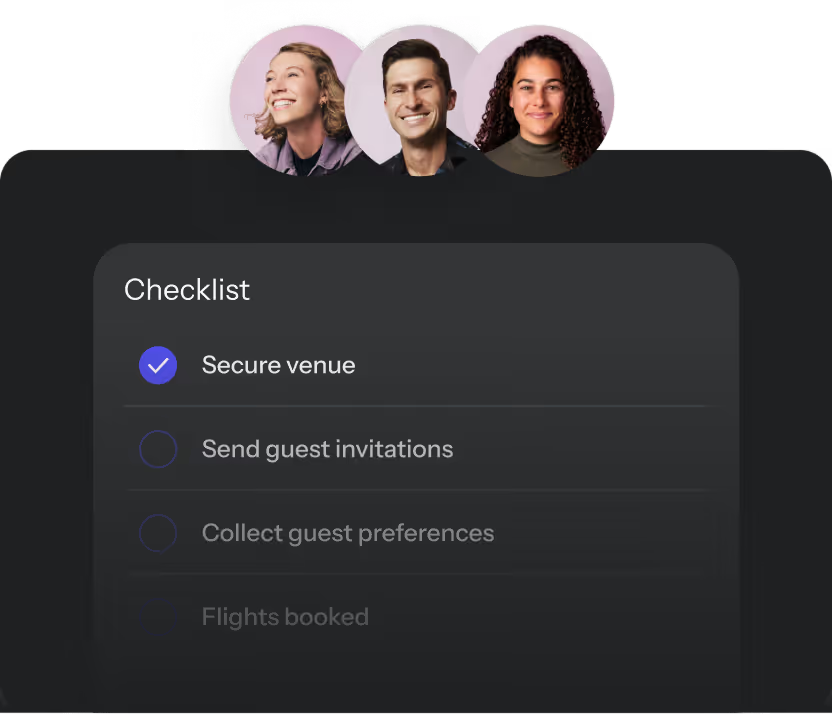
One of the hidden costs of DIY offsite planning is fragmentation: guest lists in one spreadsheet, budget in another, itinerary in a third, vendor contacts in email. BoomPop's Event Management Platform centralizes all of this in one place. You cannot measure what you cannot see.
Key platform capabilities include:
- Guest management and RSVP tracking
- Budget tracking and vendor cost visibility
- Agenda and itinerary building
- Post-event attendee surveys
- Company Event Hub for visibility across all past and upcoming events
Source hotels and vendors with cost visibility
BoomPop's vendor network, spanning over 1 million vendor partners, gives planners access to negotiated hotel and vendor rates that are not available through direct booking. Discounts of up to 40% on hotel room blocks are a concrete, budget-line saving that directly offsets platform cost. BoomPop's sourcing process also surfaces hidden costs including food and beverage minimums, AV fees, and attrition clauses before contracts are signed.
Use AI support for attendee questions
One of the most time-consuming parts of offsite logistics is answering the same guest questions repeatedly: travel details, dietary options, agenda timing, hotel check-in. BoomPop's AI-powered guest messaging handles this automatically, responding to attendee questions in natural language so the planner is not tethered to their inbox in the weeks before the event. This is especially valuable for distributed teams with attendees across time zones.
Compare DIY planning hours against managed support
The real hours involved in a DIY offsite include hotel sourcing and negotiation, vendor coordination, RSVP management, dietary tracking, travel logistics, and day-of troubleshooting. When those hours are priced at the planner's actual cost to the business, the math on a managed platform or full-service partner changes significantly. BoomPop's full-service planning option hands off end-to-end execution, from venue selection to on-site management, so internal teams can focus on content and relationships.
FAQ
How often should distributed teams hold in-person offsites?
Industry benchmarks suggest distributed teams benefit from at least two to four in-person gatherings per year. Research suggests a single gathering produces a connection boost that lasts several months, making quarterly or biannual cadences a practical starting point.
What is the 40-20-40 rule for offsites?
The 40-20-40 rule, a common framework among event planners, suggests that 40% of offsite time should go to structured work sessions, 20% to facilitated team activities, and 40% to unstructured social time, reflecting research showing that much of the highest-value connection and problem-solving happens in informal moments, not scheduled programming.
What metrics should leaders review after an offsite?
Useful post-offsite metrics combine attendee NPS and belonging survey scores with operational signals like cross-team collaboration frequency and project execution speed in the weeks following the event.
What work is better left to virtual collaboration?
Based on the Stanford research cited earlier, routine status updates, individual focused work, and information-sharing meetings are well-suited to virtual formats. In-person time is most valuable when the work requires trust-building, creative collaboration, or strategic alignment.
How can global teams make offsites more equitable?
Rotating offsite locations across regions, building in arrival buffer days for long-haul travelers, and offering travel stipends that account for varying distances are effective ways to ensure that physical distance does not create a two-tier experience.
How can planners justify offsite costs to finance?
A strong budget case combines three data points: the estimated planning hours saved through managed support priced at the planner's cost to the business, the vendor savings secured through negotiated rates, and the post-event engagement or retention signal that connects the investment to business outcomes.
Start planning in 2 minutes or less

.avif)

.svg)