
People Ops leaders own some of the most significant event investments at a growing company. The company offsite. The new hire orientation experience. The manager retreat. The all-hands that's supposed to build alignment and trust across a team that's doubled in the past eighteen months.
These aren't logistics projects. They're culture investments. And they require a different kind of visibility than a basic event registration tool provides.
The visibility problem for People Ops teams running company events looks like this: events get planned, they happen, and the data that would tell you whether they worked - what they cost, who actually attended, what people felt before and after, whether they moved the needle on the metrics People Ops is accountable for - either doesn't exist or lives in six different places that require manual assembly to produce a coherent picture.
This article is about what People Ops teams actually need from an event platform, and what to look for when evaluating whether a platform can deliver it.
The four visibility gaps that matter most
1. Total cost visibility
People Ops leaders are increasingly accountable for demonstrating ROI on culture investments. That requires accurate, complete cost data - not just the venue invoice, but the full picture including travel, staff time, and vendor costs across every line item.
Most event tools capture what you book through them and nothing else. If catering was booked outside the platform, or travel was managed through a separate expense system, or the AV vendor was paid by corporate card without going through the booking workflow, those costs are invisible to the event management platform and have to be manually reconciled later.
The platform gap: most event management tools are booking and logistics systems, not cost management systems. They show you what events you've planned, not what they actually cost in total.
What People Ops needs: a platform that maintains a live, complete budget view that includes all vendor commitments - not just those booked through the platform - and produces a total cost figure that matches the real-world accounting, not just the subset that ran through the booking tool.
2. Multi-event program visibility
People Ops at a 300-person company might be overseeing a company-wide retreat, four regional team events, a quarterly all-hands, new hire orientation experiences, and a manager development offsite - all in the same quarter. Each has a different owner, a different budget, and different intended outcomes.
Without a program-level view, People Ops leaders are operating from fragmented information: this event is on track, that one has a budget issue, the third one hasn't confirmed the venue yet. They're managing by asking rather than by seeing.
The platform gap: most event tools are designed for single-event management. Even platforms with multiple event functionality typically show individual events rather than a portfolio view - budget status, attendance pipeline, vendor commitment levels - across all active events simultaneously.
What People Ops needs: a dashboard that shows every active event, its current budget status relative to approval, attendee confirmation rate, and any open issues requiring attention - without requiring the People Ops leader to contact each event owner individually for a status update.
3. Outcome measurement infrastructure
The events People Ops runs are supposed to produce outcomes: stronger team relationships, improved alignment with company strategy, better manager effectiveness, higher belonging scores. If People Ops can't demonstrate that the events are producing those outcomes, the budget conversation gets harder every year.
Most event platforms don't touch this at all. They manage the logistics. What happens after the event - engagement pulse results, retention data, behavioral change indicators - lives in a completely separate system (the HRIS, the engagement survey platform) with no connection to the event data.
The platform gap: there's no event platform that fully automates outcome measurement. But the best ones reduce the friction: they maintain accurate attendance records for matching to HR data, they support post-event feedback collection in the same flow as pre-event communications, and they produce the cost data that forms the investment side of the ROI calculation.
What People Ops needs: a platform that at minimum makes it easy to close the loop - collect post-event feedback, export attendee lists for HR system matching, and produce accurate cost data - so the outcome measurement work requires human analysis rather than human data assembly.
4. Planner support across a distributed team
At growing companies, People Ops doesn't plan every event centrally. Regional leaders plan their own team events. HR business partners plan their own offsites. Department heads plan their own off-sites with people ops support. The People Ops team sets standards and provides guidance, but execution is distributed.
The visibility problem: distributed execution with central accountability means People Ops leaders are responsible for events they don't directly control. When something goes wrong - a vendor problem, a budget overage, an event that lands badly - the accountability travels up even when the execution was distributed down.
The platform gap: most event tools either centralize control (all events go through one account, one administrator) or are fully distributed (each team manages their own, with no central visibility). Neither is right for a growing People Ops function.
What People Ops needs: a platform that supports distributed execution with centralized visibility - different teams can plan and manage their own events, but the People Ops leader can see budget status, vendor commitments, and attendance data across all of them from a single view.
What to evaluate when selecting an event platform for People Ops
Does it maintain complete cost data, or only what's booked through the platform?
Ask specifically: if a vendor is paid outside the platform (by corporate card, by check, or through a reimbursement), does that cost appear in the event's budget view? If the answer is no, the cost visibility you think you're getting is incomplete.
Can you see across multiple events simultaneously?
Ask for a demo of the multi-event or program view. Specifically: can you see total budget committed versus approved across all active events? Can you see attendance pipeline (registered vs. confirmed vs. attended) across events without clicking into each one individually?
Does it support the outcome measurement workflow?
Ask: can the platform send pre-event and post-event surveys and associate the responses with specific attendees and events? Can you export a confirmed attendee list for HR system matching? Does the budget data export to a format your finance team can use?
Does it support distributed teams with central visibility?
Ask: can multiple team members manage their own events within a shared account? Can an administrator see all events and their status without having edit access to events they don't own? Are there permission levels that distinguish event owners from program administrators?
Why BoomPop was built for this problem
BoomPop's platform addresses the People Ops visibility gaps more directly than most event management tools because it was designed around the corporate event program - the ongoing, multi-event, multi-team experience - rather than the individual event.
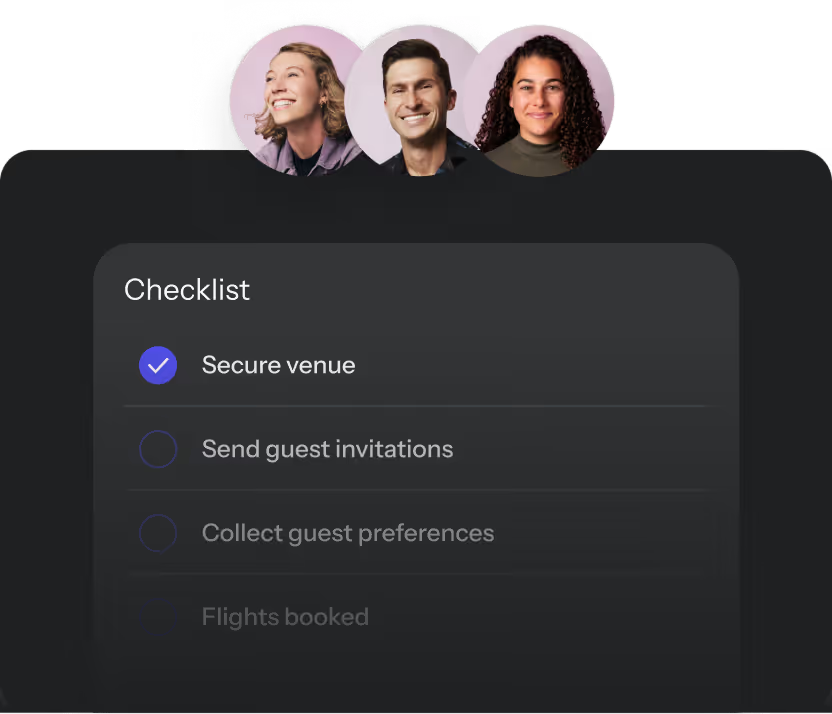
The live budget dashboard maintains a complete cost view for every event, including vendor commitments made outside the standard booking flow. The multi-event view gives People Ops leaders visibility across their full program without requiring status meetings with each event owner. Attendance tracking produces clean data for HR system matching. And the guest management tools - invitations, RSVPs, dietary preferences, post-event feedback - are designed around the internal corporate event experience, not the external conference.
The platform does what software can do. For events where People Ops needs more than visibility - where the design, facilitation, and execution of the event itself needs to be excellent - BoomPop Studio's in-house event team works alongside People Ops leaders directly. Not as a vendor you manage, but as a partner who has built and run the kinds of culture-critical events that People Ops is accountable for.
The events People Ops runs matter. They're where culture gets built or squandered, where alignment becomes real or stays theoretical, where the company's stated values get either demonstrated or exposed as aspirational. The platform that supports those events should give People Ops leaders the visibility to know whether the investment is working - and the expert support to make sure it does.
Building the business case for the right platform
Switching event platforms is a procurement conversation. People Ops leaders who want to invest in better event infrastructure need to frame the case in terms their CFO and IT leadership will respond to.
The efficiency case: current cost data assembly requires X hours per event of manual work. Across Y events per quarter, that's Z hours of staff time at fully-loaded cost. A platform that automates cost tracking and reporting recovers those hours at a specific dollar value.
The risk case: distributed event execution without centralized visibility creates budget overages that go undetected until after the fact. A platform with program-level visibility provides an early warning system that prevents overages rather than reporting them post-mortem.
The outcome case: People Ops is increasingly accountable for demonstrating ROI on culture investments. A platform that supports outcome measurement - accurate cost data, attendance records, integrated feedback collection - makes that accountability achievable rather than aspirational.
Combined, these three cases describe a platform investment that pays back in efficiency, risk reduction, and reporting capability. That's a finance conversation, not just a People Ops request.
BoomPop is the platform that makes the conversation possible. And BoomPop Studio is the team that makes the events worth reporting on.
Start planning in 2 minutes or less

.avif)

.svg)