
The budget approval came through four weeks ago. The events calendar is set. Leadership has signed off on three company-wide offsites, a sales kickoff, and a regional client summit - all before June.
The person who has to execute all of it is now staring at five separate planning workstreams, a team of two, and a request from finance to have "consolidated reporting" ready for the quarterly business review.
This is enterprise event management in practice. Not one event. A program. Multiple events running in parallel, with different teams, different vendors, different stakeholders, and a single question that echoes from every direction: "Where are we?"
Most event management software is built for a single event. Enterprise event management software has to answer that question across all of them, simultaneously - while also passing IT security review, connecting to the CRM, surviving procurement, and actually being usable by the planners who didn't ask for any of this complexity.
This article compares seven platforms that attempt to solve that problem: BoomPop, Cvent, Bizzabo, SpotMe, vFairs, Whova, and Splash.
What "enterprise" actually means in event management software
"Enterprise" in most software categories means big contracts, complex security requirements, and a long procurement process. In event management, it means something more specific.
An enterprise event program has to manage:
Portfolio visibility - Someone above the planner needs to see where the money is, which events are on track, and what the ROI story looks like, without asking the planner to build a separate report every time.
Multi-team coordination - Events aren't owned by one person at enterprise scale. Field marketing, HR, executive assistants, sales, and external agencies all touch the same event calendar. The software needs to support multiple users, roles, and permissions without creating a single point of failure.
IT and security requirements - SOC 2, GDPR, SSO, role-based access controls. Enterprise software lives in an environment where IT has to approve it, legal has to review the data processing terms, and procurement has to sign off on the contract. Platforms that can't clear those hurdles don't make it past the evaluation stage.
Procurement-grade integrations - Salesforce sync, Slack notifications, expense system connections. Enterprise teams already have a tech stack. The event platform has to fit into it, not replace it.
Scalability without added headcount - The event program grows, but the team doesn't always grow with it. The platform has to automate the work that used to require more people.
Most platforms that call themselves "enterprise" check two or three of these boxes. The ones that check all five while remaining usable by the planner who isn't an IT engineer are genuinely rare.
Who this is for
The reader evaluating enterprise event management software is usually one of these people:
- A VP of Marketing or Head of Events managing a program of 10–50+ events annually across multiple teams and formats
- An executive assistant or chief of staff responsible for coordinating company-wide events - offsites, SKOs, all-hands - and reporting on them to leadership
- A people ops or HR leader who owns the employee events budget and needs to justify it with outcomes, not just receipts
- An IT or procurement stakeholder evaluating security, compliance, and integration requirements before a platform purchase
The criteria that matter for each of these people are different, and a good enterprise platform has to work for all of them.
How we evaluated these platforms
We evaluated these seven platforms against the criteria that predict whether enterprise teams actually adopt and continue using the software - not whether it has an impressive feature list on a demo slide.
Program management, not just event management: Can you see across your entire event portfolio, or only one event at a time?
Planner usability under pressure: The real test isn't a polished demo. It's whether the planner running logistics at 11pm three days before the event can find what they need without training.
IT and security clearance: SOC 2 compliance, GDPR support, SSO, role-based permissions. These aren't nice-to-haves at enterprise scale - they're table stakes.
Integration depth: Native connections to Salesforce, Slack, marketing automation platforms, and expense systems. Zapier workarounds aren't the same as real integrations.
AI that does real work: Automated RFPs, AI-assisted planning, intelligent guest communication. Not "AI" as a marketing label on a search filter.
ROI reporting: Can the platform answer "what did our events cost and what did they produce?" without manual data assembly?
The 5 best enterprise event management software platforms
1. BoomPop - best for enterprise teams that need AI-powered end-to-end event management with real planner usability
Enterprise event management has a dirty secret: the more powerful the platform, the less likely the people actually running the events are to use it. Tools get purchased at the VP level, fail at the planner level, and quietly get supplemented by spreadsheets within six months.
BoomPop was designed to break that pattern. It's built for enterprise scale - trusted by Google, Netflix, Dropbox, Nike, and hundreds of other enterprise organizations - but optimized for the planner who needs to run a 150-person sales kickoff without a week of training.
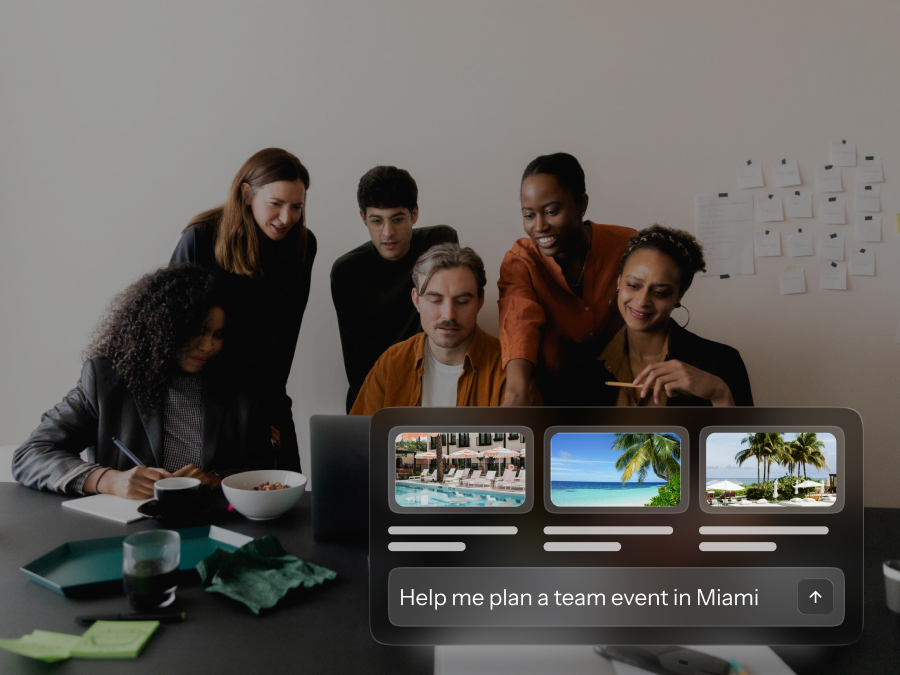
The AI is where the operational difference shows up most clearly. Type a brief description of the event you need - location preference, headcount, budget range, event type - and BoomPop's AI queries real-time data across a vetted network of over one million venues and vendors to generate complete event options, including pricing, availability, and logistics recommendations. Not a list of links. An actual starting point.
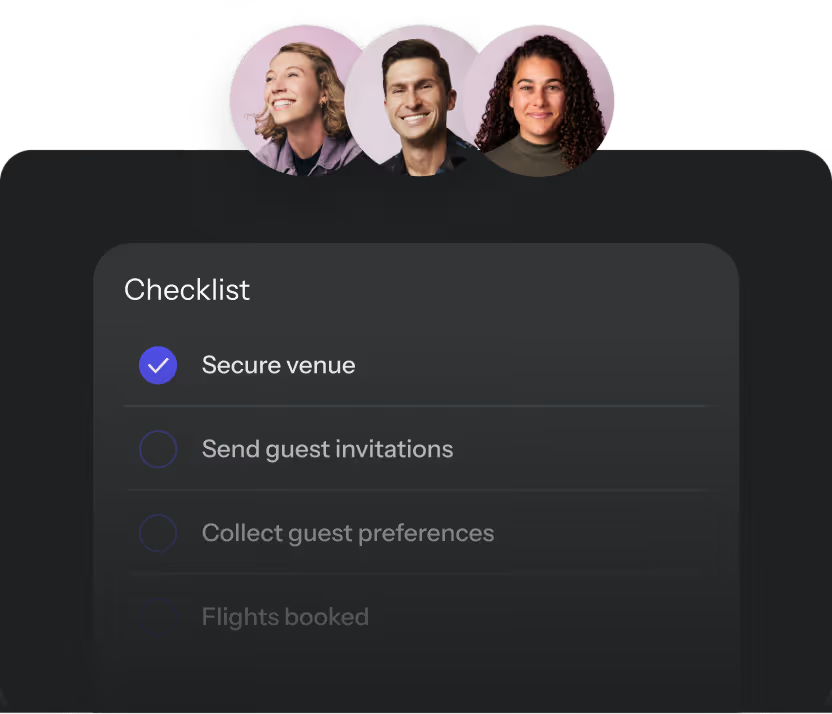
From there: automated RFPs go out simultaneously to multiple venues, follow-ups happen automatically for non-responses, and contract review and negotiation support is available through BoomPop Studio for teams that need human expertise alongside the software. Guest communications - invitations, RSVPs, dietary preferences, day-of questions - run through AI that handles direct messages via Slack or text so the planner isn't fielding individual questions across multiple channels.
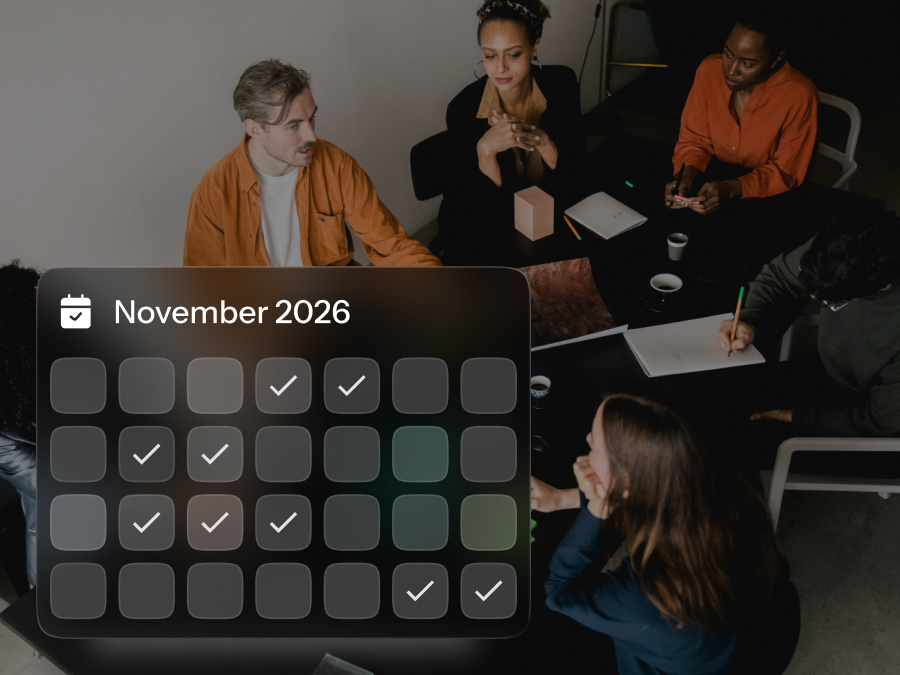
For enterprise teams specifically, the multi-event visibility and budget dashboard give leadership a real-time view of spending and status across the program without requiring a planner to build a separate report. Finance and operations stakeholders get the consolidated visibility they want; planners get the automation they actually need.
BoomPop also supports the Navan integration for organizations using Navan for corporate travel and expense management - bringing event planning and corporate travel into the same operational view.
Key enterprise capabilities:
- AI Itinerary Builder: Natural language input generates complete, real-data event options in minutes
- Automated RFP and follow-up: Simultaneous outreach to venues, automated follow-up for non-responses, no more chasing
- AI guest communication: Fields attendee questions via text and Slack, reducing planner interruption load
- Live budget dashboard: Real-time spend tracking across all vendors, shareable with finance and leadership
- Multi-event program view: Portfolio visibility across simultaneous events for managers and executives
- BoomPop Studio: Human event planners available for high-complexity events, integrated into the platform
- Enterprise network: Over one million vetted venues and vendors; 60,000+ hotel nights booked for enterprise clients
Published benchmarks: clients save 25–40% on event costs and hundreds of hours per event. Ranked #7 fastest-growing software company on the 2025 Inc. 5000.
Choose BoomPop when you need enterprise-grade event management that your planners will actually use - where the AI does the sourcing, logistics, and communication work instead of just organizing it. Avoid it if your primary need is a public-facing conference platform with exhibitor management or a virtual-events-only infrastructure.
2. Cvent - good for large running high-volume external conferences with procurement-grade requirements
Cvent is the legacy category leader, and for a specific buyer profile it's the right call: large organizations managing dozens of external conferences, trade shows, or corporate events annually, where the events team is dedicated, the IT requirements are strict, and the procurement process demands an established vendor with documented compliance.
Cvent's strength is its comprehensiveness. Venue sourcing through a database of 300,000+ properties, registration and attendee management, mobile event apps, email marketing, advanced reporting, and deep Salesforce integration - the full lifecycle in one platform, with the audit trails and data governance enterprise IT teams require.
The tradeoff is real and consistent across every category of user review: Cvent is powerful and overwhelming in roughly equal measure. The interface requires training. Setup for a new event requires navigating a platform that was built for event professionals, not accidental planners. Implementation is measured in months, not weeks, and the cost reflects that.
Cvent is also primarily oriented toward external, conference-style events - the kind with registration pages, session tracks, exhibitor booths, and sponsor management. For internal company events (offsites, SKOs, team retreats), it's often more than the situation requires.
Choose Cvent when you have a dedicated enterprise events team managing high-volume external conferences and need procurement-grade compliance, deep Salesforce integration, and an established vendor relationship. Avoid it when your primary event type is internal team events, the planner isn't a dedicated event professional, or speed and usability matter more than feature breadth.
3. Bizzabo - good for B2B conference teams focused on attendee engagement and sponsor ROI
Bizzabo has carved out a specific and defensible position in the enterprise segment: B2B conferences where attendee engagement, networking facilitation, and sponsor return-on-investment are the primary success metrics.
Its Sponsor ROI Engine - which uses AI-driven matchmaking and CRM attribution to connect sponsor activity to pipeline outcomes - is a genuine differentiator for conference teams that have to justify sponsorship programs to revenue leadership. The AI attendee copilot (Bizzy) and deep Salesforce and Marketo integrations round out a platform that's genuinely built for demand-generation-oriented event programs.
The honest assessment: Bizzabo dropped from Leaders to Visionaries in Gartner's 2026 Magic Quadrant for Event Marketing and Management Platforms, with the report noting slower growth, limited sales structure depth, and questions about its long-term AI vision. That doesn't make it a bad platform - it makes it one that needs to show continued execution. Teams currently on Bizzabo report strong satisfaction with attendee experience features; the concern is more about where the platform is headed than where it is today.
Choose Bizzabo when your enterprise event program is centered on B2B conferences, sponsor ROI is a key accountability metric, and you need deep CRM attribution. Avoid it if your event portfolio is primarily internal, the events team is small, or you need a platform that's easy to implement quickly.
4. SpotMe - good for regulated industry enterprises with compliance-heavy event requirements
SpotMe has a well-defined and defensible niche: enterprise events in life sciences, pharma, and financial services, where compliance documentation, HCP (healthcare professional) tracking, data residency, and audit trails aren't optional features but legal requirements.
Its mobile event app is well-regarded for attendee engagement - polling, Q&A, personalized session recommendations - and its integrations with Salesforce, HubSpot, and Veeva (the CRM used widely in pharma) are genuinely deep. For the compliance-driven use case, SpotMe's documentation and security architecture are purpose-built in a way that generic event platforms aren't.
The scope limitation is worth stating plainly: SpotMe is built for in-person, hybrid, and virtual conferences and meetings. It's not built for the corporate offsite and group travel use case that represents a significant share of enterprise event spend. And the 2026 Gartner assessment dropped SpotMe from Challenger to Niche Player, citing execution gaps and complexity from its dual-brand approach with Onomi for life sciences.
Choose SpotMe when your enterprise events run in regulated industries - pharma, life sciences, financial services - where HCP compliance, audit trails, and data residency requirements are non-negotiable. Avoid it when compliance isn't a primary driver, or your event portfolio includes significant internal team events and corporate travel.
5. vFairs - good for enterprise teams running large-scale virtual and hybrid conferences
vFairs has held its position in Gartner's Leaders quadrant for two consecutive years, and the recognition is earned: for large virtual and hybrid conferences, vFairs offers AI-driven attendee matchmaking, a mobile-first support assistant, real-time analytics, and 3D virtual venue capabilities that create a genuinely differentiated attendee experience.
Its AI Event Agenda Builder and real-time lead qualification tools are meaningfully useful for conference teams managing large attendee flows. The platform's caution from Gartner: slower new customer acquisition than peers and a complex attendee profile setup that creates friction for first-time users.
vFairs is primarily a conference platform with strong virtual and hybrid capabilities - it's not built for corporate offsites, group travel, or the sourcing-heavy planning that dominates internal enterprise event programs. If your event portfolio skews heavily toward external conferences with a virtual component, vFairs earns serious consideration. If it skews toward internal team events, it's solving the wrong problem.
Choose vFairs when your enterprise event program centers on large virtual or hybrid conferences and you need proven AI matchmaking, strong analytics, and a platform that's already earned Gartner Leader recognition. Avoid it when internal events, offsites, or corporate travel planning are primary use cases.
What enterprise event teams actually struggle with that software needs to solve
The multi-event coordination problem
When four events are running in parallel and each one has its own planner, vendor set, budget line, and stakeholder group, the breakdown happens in the gaps between them. Nobody owns the portfolio view. Finance asks for consolidated reporting and the answer is "we'll have to pull that together." The EVP wants to know total spend across Q2 events and the answer takes three days to produce.
The platforms that solve this provide a real multi-event dashboard - not just event-by-event navigation. That view needs to show budget status, headcount, vendor commitments, and open action items across the whole program without requiring manual aggregation. BoomPop's multi-event view and Cvent's enterprise reporting both address this; most mid-market platforms don't.
The "event ops in hard mode" problem
Enterprise events have more moving parts than SMB events in every dimension: more vendors, more guests with more specific preferences, more approval chains, more legal review on contracts, more eyes on the budget. The planner carrying all of this is often doing it without direct reports and with a timeline that doesn't accommodate a software learning curve.
Tools that reduce the operational load through AI automation - rather than just organizing the load more neatly - are categorically different from tools that digitize the same amount of manual work. The distinction is real: an automated RFP that goes to twelve venues simultaneously and follows up on non-responses is not the same as a better spreadsheet. AI guest communication that fields dietary restriction questions without involving the planner is not the same as a better email template.
The ROI reporting requirement
Enterprise events budgets are getting scrutinized more, not less. The question isn't "did we have good events" - it's "what did the events produce?" For external events, that's pipeline influenced, deals closed with reference to event attendance, and sponsor revenue generated. For internal events, that's retention impact, engagement scores, and cost per attendee benchmarks against market norms.
The platforms that make this reporting automatic - connecting event attendance to CRM records, surfacing cost data without manual invoice chasing, benchmarking spend against BoomPop's proprietary database of comparable events - give the events team the data they need to protect the budget. The ones that require manual assembly of post-event data are adding work at the worst possible time.
Enterprise event software evaluation checklist
Before signing a contract, run these checks:
Security and compliance
- Is the platform SOC 2 Type II certified?
- Does it support GDPR and, if relevant, CCPA compliance?
- Is SSO available and compatible with your identity provider?
- Does it offer role-based access controls that match your team structure?
Integration readiness
- Does it connect natively to Salesforce, or via Zapier only?
- Can it sync with your travel and expense platform?
- Does it integrate with Slack or Microsoft Teams for team coordination?
- What does the API look like if you need custom integrations?
Procurement and implementation
- What's the realistic implementation timeline to first live event?
- What professional services are required, and what's the additional cost?
- What does the contract look like on data ownership and portability?
- Is there a dedicated customer success manager, or ticket-based support?
Planner usability
- Demo the platform with the person who will actually run events in it, not just the buyer
- Run a test scenario: "It's 3 days before the event and a vendor hasn't confirmed. What does the planner do?"
- Ask to see the mobile experience - most events require real-time updates from venues and vendors
FAQ
What separates enterprise event management software from standard event software?
Enterprise platforms need to handle multiple events simultaneously with portfolio-level reporting, support multi-team coordination with role-based permissions, pass IT security requirements including SOC 2 and SSO, and integrate natively with CRM and marketing automation platforms. Standard event software typically manages one event at a time with lighter security requirements and fewer integration demands.
How do we make the ROI case for enterprise event software to the CFO?
The clearest path: quantify the time your current team spends on manual sourcing, vendor coordination, and post-event reporting, then benchmark it against published time savings (BoomPop clients report hundreds of hours saved per event). Add the cost savings from automated RFP negotiation - BoomPop clients report 25–40% savings on event costs. Put both numbers against the platform cost. The math is usually straightforward once the manual time is honestly estimated.
What's the realistic implementation timeline for enterprise event software?
It varies significantly by platform complexity and internal readiness. BoomPop is designed for first-event use within a week. Cvent typically takes two to three months for full implementation. Bizzabo and SpotMe are in the four-to-eight-week range depending on integration requirements. The honest question to ask in procurement: "When can we run our first live event in this platform after contract signature?"
How do we handle multi-team governance - field marketing, HR, executive team - in one platform?
Look for role-based permissions that let different teams own their events while giving centralized visibility to program managers. The ability to set spending approvals at different levels, restrict vendor access by team, and aggregate reporting across all teams without merging all events into one undifferentiated view is what separates enterprise-ready governance from basic user management.
Do we need different software for internal events (offsites, SKOs) versus external events (conferences, customer events)?
Not if you choose the right platform. BoomPop handles both, with sourcing and logistics tools built for internal team events and program management capabilities that extend to external conferences. Cvent is stronger for external conferences at high volume. The mistake to avoid is choosing a conference platform for a program that's primarily internal, or choosing an offsite tool that can't handle external attendee registration and engagement.
What data security questions should IT ask during evaluation?
Data residency (where is attendee data stored and processed?), data retention and deletion policies, penetration testing frequency and results availability, sub-processor list and data sharing agreements, and breach notification procedures. For enterprise procurement, request the SOC 2 Type II report, the GDPR data processing agreement, and documentation of SSO compatibility with your identity provider before finalizing any contract.
Start planning in 2 minutes or less

.avif)

.svg)