
Leadership approved the offsite budget in January. By March, the calendar has a date, the hotel is "basically confirmed," and the agenda is a Google Doc with five bullet points that says "team building TBD."
Someone will own the actual execution of this. That person will spend the next six weeks managing a vendor who won't reply, chasing dietary restrictions across a 75-person guest list, rebuilding the budget when the original quote didn't include AV, and smiling through all of it because the event is supposed to be "fun."
Meanwhile, leadership will show up, enjoy the offsite, and call it a success because nobody saw the work that made it work.
This is corporate event management in practice. Not a registration page. Not a ticketing flow. The unglamorous, high-stakes logistics of bringing a company together in person - and the very real question of whether that gathering actually accomplished anything, or just burned $80,000 on an open bar and a trust fall.
The right corporate event management software changes two things: it reduces the operational burden on the person running the event, and it creates the conditions for events that produce real outcomes - for culture, for team performance, for business results - instead of events that just check the "we did a thing together" box.
This article compares seven platforms that approach that problem differently: BoomPop, Cvent, Teamout, Whova, SpotMe, vFairs, and Eventbrite.
What corporate event management software actually needs to do
Corporate events span a wide range of types, and the software requirements shift meaningfully depending on which type you're planning.
Internal team events - offsites, retreats, sales kickoffs, all-hands, team-building events - are the highest-stakes category for most companies. They're where culture is built or squandered. They typically involve group travel, hotel blocks, vendors, and logistics that external conference tools aren't built for. They also tend to be planned by people who have other jobs.
External corporate events - customer conferences, user summits, analyst briefings, client entertainment - require different capabilities: registration, attendee engagement, sponsor management, and brand-consistent experiences for an audience that isn't your employee.
Hybrid programs - companies running both types regularly - need a platform that handles both without requiring two separate systems and two separate learning curves.
The best corporate event management software addresses all three. The platforms that fall short usually do so because they were built for one type and assumed it would generalize.
The problem with "get them in a room"
There's a pattern that plays out consistently at companies that spend real money on corporate events and still end up with forgettable ones.
Leadership decides the company needs to gather. They approve a budget. Someone gets assigned to book it. That person books a nice hotel, arranges some activities, orders catering, and produces an event that is logistically fine and experientially forgettable.
The issue isn't the execution. It's that nobody defined what "success" looked like before the planning started. Was the goal to give the distributed team genuine face time? To realign around a strategic direction? To celebrate a milestone in a way that would actually be remembered? Or just to have done the offsite?
"Get them in a room" is not a strategy. An open bar is not culture. A DoorDash gift card is not connection.
The software that supports purposeful corporate events does more than manage logistics - it creates structure around intent. What is this event for? Who needs to experience what? What does the attendee leave with that they couldn't have gotten from a Zoom call?
BoomPop's approach to this problem is built into the product: the planning process starts with the outcome, not the venue.
How we evaluated these platforms
We evaluated seven platforms against the criteria that predict whether corporate events actually land - logistically and culturally.
End-to-end workflow for internal events: Venue sourcing, group travel, vendor coordination, guest management, and budget tracking - not just the registration and attendee-facing side.
AI that reduces real work: Automated RFPs, itinerary generation, and guest communication. The difference between software that organizes work and software that eliminates it.
Outcome design support: Does the platform help you plan events with purpose, or does it just help you fill a calendar?
Budget transparency: Real-time cost visibility, not post-event reconciliation surprises.
Planner experience: Who is actually going to run this in the platform - a dedicated event professional, an EA, a people ops manager? The right software works for all of them.
The 6 best corporate event management software platforms
1. BoomPop - best for companies that want corporate events with real outcomes, not just logistics managed
Most corporate event platforms treat the event as a logistics problem. BoomPop treats it as an outcome problem that happens to have logistics attached.
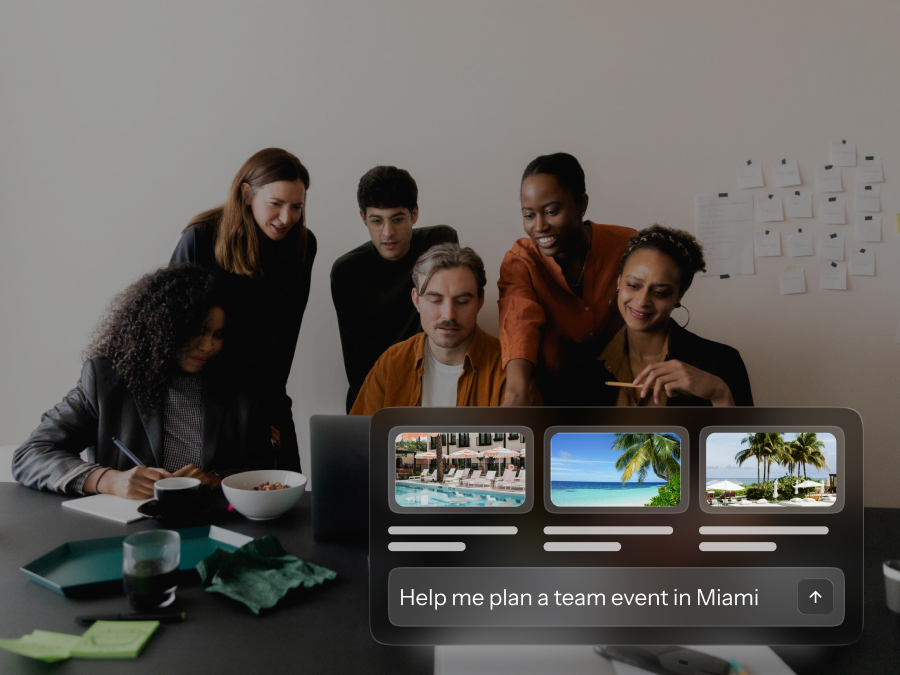
That distinction shows up in how the planning process works. When you describe an event to BoomPop - team size, location range, type of gathering, budget - the AI doesn't just search a database. It asks what you're trying to accomplish and surfaces options that match the goal, not just the parameters. A 50-person sales kickoff and a 50-person culture retreat have the same headcount and similar budget ranges. They need completely different venues, programming, and structures to succeed. BoomPop's AI understands that difference because it's trained on a proprietary database of real corporate events - what worked, what didn't, what produced the outcomes teams were actually trying to create.
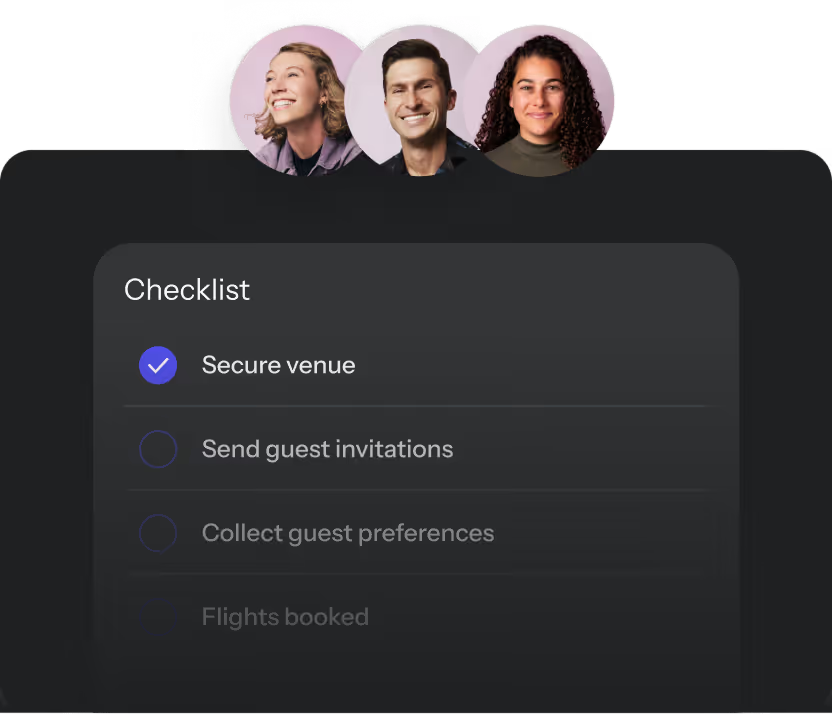
The operational side is where BoomPop saves the most time. Automated RFPs go to multiple venues simultaneously. Vendor follow-up happens automatically for non-responses - the ghosted-by-hotels problem that costs planners days of wasted energy. Guest websites launch in minutes. Dietary restrictions, RSVPs, and room preferences are collected and managed in the platform. AI fields day-of guest questions via text and Slack so the planner can actually be present at the event they just spent six weeks building.
Budget tracking stays current as bookings come in - no more reconstructing total cost from twelve different vendor invoices after the fact. The post-event report is ready to share with finance without a data assembly project.
For companies where events are also an employee experience investment - where how the offsite feels is directly connected to retention, engagement, and culture - BoomPop's in-house event team (BoomPop Studio) is available for events that need full-service support. This isn't a separate vendor relationship; it's integrated into the same platform.
Key capabilities:
- AI Itinerary Builder: Outcome-oriented event options generated from a natural language brief, grounded in real data
- Automated RFP and vendor follow-up: Simultaneous outreach, automatic follow-up for non-responses
- Guest management: Website, invitations, RSVPs, dietary restrictions, preferences - one place
- AI guest communication: Text and Slack-based support that fields attendee questions without involving the planner
- Live budget dashboard: Real-time cost tracking across all vendors, shareable with leadership and finance
- BoomPop Studio: Human event planners for high-touch, full-service events
- Vetted network: 1M+ venues and vendors; clients include Google, Netflix, Dropbox, Nike
Published benchmarks: 25–40% cost savings and hundreds of hours saved per event. Ranked #7 fastest-growing software company on the 2025 Inc. 5000. Over 60,000 hotel nights booked for corporate clients.
Choose BoomPop when your corporate events are investments in culture and team performance - not just logistical obligations - and you need the software to do the heavy lifting so the planner can focus on the experience itself. Avoid it if your primary need is a public conference platform with exhibitor management or virtual-only events infrastructure.
2. Cvent - best for large organizations managing external corporate conferences at enterprise scale
Cvent is the dominant platform for enterprise-scale external events: large conferences, trade shows, annual customer summits, and corporate events with hundreds or thousands of external attendees. Its venue sourcing database, registration workflows, mobile event apps, and reporting capabilities are genuinely comprehensive for that use case.
For internal corporate events - team offsites, SKOs, culture-building retreats - Cvent is typically more than the situation requires, and the learning curve shows. The platform was built for dedicated event professionals managing high-volume external programs, and the interface reflects that. Reviewers consistently describe it as powerful but overwhelming, especially for planners who aren't using it full-time.
The cost and implementation timeline also skew toward enterprise external events. For companies whose primary event challenge is the internal team gathering, the investment rarely matches the return.
Choose Cvent when your corporate event program is primarily large-scale external conferences, you have a dedicated events team, and enterprise compliance and integration requirements matter. Avoid it when internal team events are your primary use case, the planner isn't a full-time event professional, or you need to get an event live quickly.
3. Teamout - best for small teams planning straightforward retreats without full event infrastructure
Teamout is purpose-built for team retreats and corporate offsites, with a focus on venue discovery and booking. For small teams - typically under 50 people - planning a straightforward retreat in a specific destination, Teamout's venue catalog and booking workflow reduce the initial friction meaningfully.
The scope is narrow by design. Teamout handles the sourcing and booking side; it doesn't provide the full planning infrastructure - budget dashboards, guest management, vendor coordination, AI-assisted logistics - that more complex events require. For its target use case, that's appropriate. For teams that need more than venue discovery, the platform reaches its ceiling quickly.
One notable strength: Teamout promises venue quotes within 24 hours, which is genuinely faster than the typical hotel sourcing process for small group events.
Choose Teamout when you're a small team planning a simple retreat and your primary bottleneck is finding and booking a venue quickly. Avoid it when you need end-to-end event management, guest communication, budget tracking, or logistics support beyond the initial booking.
4. Whova - best for corporate conference organizers focused on attendee engagement
Whova's strength is conference-style attendee engagement: networking tools, session scheduling, speaker management, live polling, and a mobile event app that consistently earns high marks for ease of use. For corporate events that look more like conferences - industry events, customer summits, large all-hands with multiple session tracks - Whova delivers a polished attendee experience.
The limitation for internal corporate events is that Whova optimizes heavily for the attendee-facing side and less for the planner-facing side. Reviewers note that the platform's back-end is better suited to event administrators managing conference logistics than to planners coordinating multi-vendor offsite experiences. It also doesn't address the sourcing and group travel side of corporate event planning at all.
Choose Whova when your corporate event is conference-style - external attendees, multiple sessions, networking as a core feature - and attendee engagement is the primary success metric. Avoid it when your event is an internal team gathering that requires venue sourcing, group travel logistics, and end-to-end vendor management.
5. SpotMe - best for corporate events in regulated industries with compliance requirements
SpotMe's position in corporate event management is specific: regulated-industry corporate events where compliance documentation, data security, and audit trails are requirements, not preferences. Pharma companies running medical education events, financial services firms running client conferences, and life sciences organizations managing HCP interactions are its core market.
Outside of that context, SpotMe's complexity and cost are difficult to justify. The 2026 Gartner assessment dropped it from Challenger to Niche Player, citing execution gaps and organizational complexity from its dual-brand approach. For the compliance use case it serves, it remains a serious option. For general corporate event management, it's solving a problem most companies don't have.
Choose SpotMe when your corporate events run in regulated industries and compliance documentation is non-negotiable. Avoid it when compliance isn't the primary driver - the platform's specialized capabilities come at a cost in complexity and price that doesn't make sense for general corporate event programs.
6. vFairs - best for companies running large virtual or hybrid corporate events
vFairs occupies a well-defined position in the corporate events category: large-scale virtual and hybrid events where the online attendee experience matters as much as the in-person one. Its 3D virtual venue capabilities, AI matchmaking, and real-time analytics make it a serious option for companies running global all-hands, virtual conferences, or hybrid events with significant remote participation.
For fully in-person corporate events - the offsite, the SKO, the client dinner, the team retreat - vFairs isn't relevant. It's built around the virtual experience, and using it for in-person events means paying for capabilities you won't use while missing the in-person logistics support you need.
Choose vFairs when virtual or hybrid is the primary format for your corporate events and you need a mature platform with strong analytics and AI attendee tools. Avoid it when in-person logistics, venue sourcing, or group travel are core to what you're planning.
What makes a corporate event actually worth the money
The forgettable offsite problem
Companies spend $2,000–$3,500 per person on corporate offsites and retreats. At 75 people, that's $150,000–$260,000 for two or three days. The question that almost nobody asks before the planning starts: what will the team remember in six months?
Not "what activities are we doing" - what experience are we creating? What will shift in how this team works together, communicates, or believes in the direction the company is heading?
Events that answer that question before the venue is booked produce outcomes that justify the spend. Events that answer "what hotel has availability in March" produce photos that get posted to Slack and forgotten by April.
The software that supports purposeful corporate events does more than execute logistics. It creates structure for planning intent - starting with outcome, working backward to programming, then to venue and vendor selection. BoomPop's planning process is built around this sequencing. The AI doesn't just optimize for price and availability; it surfaces options that match what you're trying to create.
The invisible labor problem, revisited
The person planning a corporate offsite is often doing it alongside a full-time job. An executive assistant who also manages the executive's calendar. A people ops manager who also owns onboarding, engagement surveys, and benefits administration. A marketing coordinator who handles events as one of eight responsibilities.
That person is going to manage vendor relationships, dietary restrictions, hotel room assignments, ground transportation logistics, and day-of problem-solving - and they're going to make it look effortless because the whole point is that the attendees don't feel the seams.
Software that acknowledges this reality - that automates the work instead of just organizing it - is categorically different from software that creates a more attractive spreadsheet. The hours saved on automated RFPs, follow-up sequences, and AI-handled guest communications are real hours that go back to the person running the event. That math matters for a team whose bandwidth is already stretched.
The ROI conversation that nobody wants to have
Events and entertainment is often a company's second-largest expense after payroll for teams with significant hybrid or distributed workforces. That budget is under increasing pressure to show return.
The ROI case for corporate events is real but requires the data to make it. Retention rates for employees who attend meaningful offsites. Engagement scores before and after high-investment gatherings. Revenue per rep in quarters following well-designed sales kickoffs.
Software that captures the right information - cost per attendee by event type, attendance patterns across teams, post-event feedback - gives people ops and finance the data they need to make the case that the event budget is producing something. Platforms that leave the post-event reporting to manual assembly don't make that case easy to build.
How to plan a corporate event that's worth the investment
Start with the outcome, not the date
Most corporate event planning starts with "we need to do this by [month]." Better planning starts with "we need [outcome] and we have [budget]." Those are different conversations and they produce different events.
Outcomes worth planning toward: teams that haven't met in person building working relationships before a critical project. Distributed company aligning around a strategy shift. Sales team entering a new fiscal year with conviction about the product direction. Culture investing in the milestone recognition that actually lands.
Outcomes that don't justify the spend: "we do an offsite every year." "People seemed like they needed it." "Other companies do this."
Define who the event is really for
Corporate events fail in a specific way: they're designed for the ideal attendee rather than the actual one. The agenda assumes everyone is energized by the same activities. The structure assumes everyone processes connection through the same mode. The evening event assumes everyone's idea of unwinding is the same.
The best corporate events design for range - they create space for different kinds of engagement rather than forcing everyone through the same experience. That requires intentionality at the planning stage, not just better logistics.
Use the debrief
The post-event debrief is where most of the value from corporate events gets left on the table. What was the energy in the room? What conversations happened that wouldn't have happened on a Zoom call? What decision got made that had been stuck for months?
That information should feed into how the next event is designed. Software that captures it - post-event surveys, attendee feedback, facilitator notes - turns each event into a data point that improves the next one.
FAQ
What's the difference between corporate event management software and general event management software?
Corporate event management software addresses the specific operational needs of company-organized events: group travel, internal budget accountability, multi-vendor coordination, and integration with HR and finance systems. General event management software often focuses on the public-facing elements - registration, ticketing, attendee engagement - without addressing the logistics that define internal corporate event planning.
How do I justify the ROI of a corporate offsite to leadership?
The most defensible case combines cost efficiency data (BoomPop clients report saving 25–40% on event costs through automated negotiation and vendor pricing) with outcome measurement (post-event engagement surveys, retention tracking, pipeline data for sales events). The starting point is agreeing on what the event is supposed to produce before it happens - which makes the post-event measurement meaningful rather than retrospective.
How far in advance should we start planning a corporate offsite?
For events of 50 or more people, 6–8 weeks minimum with a platform that automates venue sourcing in parallel. Without automation, add another two to four weeks for the manual RFP and follow-up cycle. For destination events requiring significant travel coordination, 10–12 weeks gives you meaningful options before the best venues and dates are gone.
What's a reasonable cost per person for a corporate offsite?
Corporate retreats typically run $2,000–$3,500 per person for a two-to-three-day event, depending on destination, accommodation tier, and programming. Full-service execution with a platform like BoomPop helps teams land toward the lower end of that range through automated negotiation and competitive vendor pricing - without sacrificing the experience that makes the investment worthwhile.
Do we need different software for offsites versus conferences?
Not if you're using BoomPop, which is built to handle both. If you're evaluating other platforms, the answer is often yes: platforms built for conferences (Cvent, Whova, vFairs) don't address offsite logistics, and platforms built for simple retreat booking (Teamout) don't handle the complexity of multi-session conference programs. The full-spectrum corporate event program usually ends up on two or three platforms unless it's running through BoomPop.
What separates a good corporate event from a forgettable one?
Intentionality at the design stage. The best corporate events are built backward from a specific outcome - a team alignment, a cultural moment, a performance milestone - with programming, venue, and structure chosen to serve that outcome. The forgettable ones are built forward from a date and a budget with "TBD" where the purpose should be. The logistics can be perfect and the event can still miss if nobody answered the question of what it was for.
Start planning in 2 minutes or less

.avif)

.svg)